
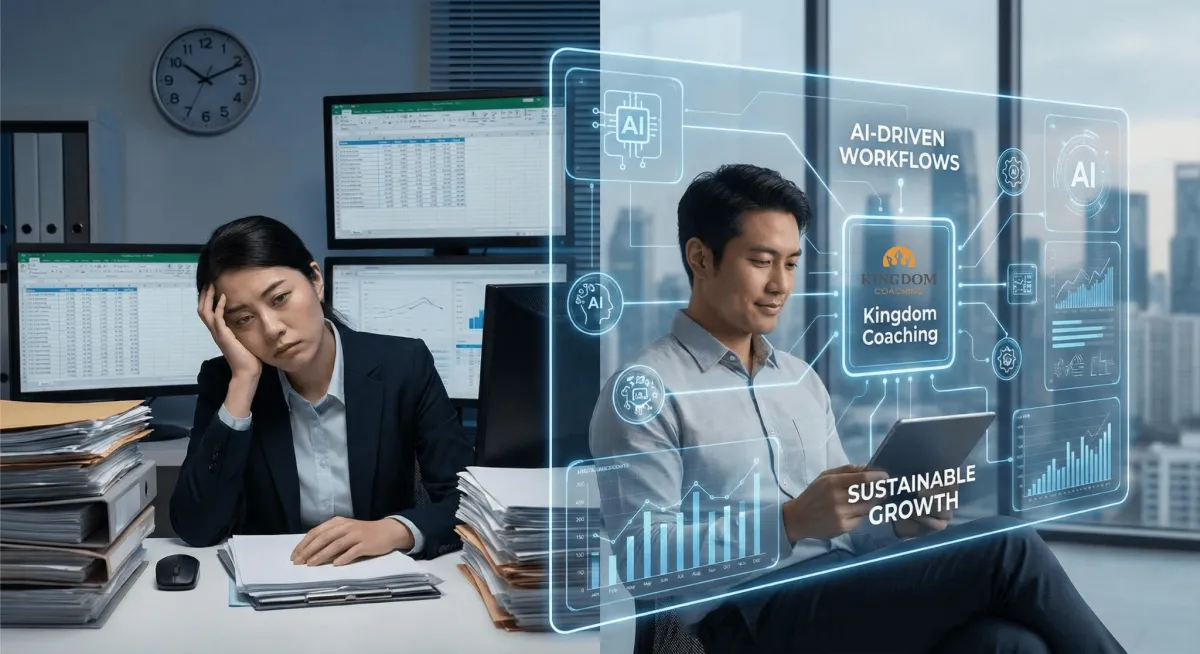
Tired of Burnout? How AI Systems Help Leaders Grow Their Business Without the Exhaustion
Business leaders are drowning in decisions. The constant pressure to respond, approve, estimate, follow up, and execute has created a workload that bleeds into evenings, weekends, and mental space that should be reserved for strategy. Growth becomes painful when every additional client means more hours, more stress, and less capacity to think clearly.
This exhaustion isn't a badge of honor, it's a business liability. When leaders operate in a perpetual state of cognitive overload, decision quality suffers, team morale drops, and opportunities slip through the cracks. The promise of scaling often delivers the opposite: more chaos, less clarity, and a leadership team running on fumes.
The solution isn't working harder or hiring more people to patch broken systems. It's about reclaiming mental bandwidth through intelligent automation that handles the repetitive, time-consuming work that drains focus from high-value activities.
The Hidden Cost of Manual Operations
Most business owners don't realize how much cognitive energy they lose to routine tasks until they track it. According to Microsoft's 2025 Work Trend Index, employees face an average of 275 interruptions daily, creating what researchers call the "infinite workday." For leaders, this translates to fragmented attention, delayed strategic thinking, and the constant feeling of being behind.
Consider the daily reality for Minnesota service businesses: A contractor spends three hours drafting estimates for projects that may never close. A coach manually follows up with prospects who inquired weeks ago. A government agency processes applications using systems that require multiple redundant entries. Each of these tasks is necessary, but none require executive-level thinking.
The problem compounds when businesses try to scale. Adding clients without adding automation means leaders simply multiply their workload. The IBM 2025 CEO Study reveals that 39% of CEOs are now deploying AI specifically to prevent what they call "high-value burnout," which is the exhaustion that occurs when skilled professionals spend their time on tasks that don't require their expertise. At top-performing firms implementing this approach, employee experience improved by 72%.
Common exhaustion triggers include:
Responding to the same questions from prospects repeatedly
Creating estimates and quotes from scratch for each inquiry
Manual follow-up sequences that require remembering who needs contact
Scheduling meetings through endless email exchanges
Data entry across multiple platforms for the same information
Status updates that pull leaders away from strategic work
The financial impact extends beyond wasted hours. When leaders operate in constant reactive mode, they miss market opportunities, delay critical decisions, and create bottlenecks that slow the entire organization. The cost isn't just personal exhaustion, it's measurable revenue loss and competitive disadvantage.
AI Workflow Automation: Returning Time to Strategy
The shift from traditional automation to AI-powered systems represents a fundamental change in how businesses operate. Unlike basic automation that follows rigid if-then rules, modern AI workflow automation handles complex, judgment-based tasks that previously required human intervention.
An AI employee doesn't just execute predefined scripts; it learns patterns, adapts to context, and manages entire workflows from initiation to completion. For instance, when a prospect submits an inquiry through your website, an AI system can qualify the lead, schedule a consultation, send preparatory materials, follow up if they don't show, and log all interactions in your CRM without any manual input.
McKinsey's 2025 State of AI Report found that 62% of leading organizations now use AI agents for deep research and service-desk management. These aren't simple chatbots; they're systems capable of handling what McKinsey calls "analytical marathons": complex research, data synthesis, and decision support that would otherwise consume hours of leadership time. The result is a significant reduction in decision fatigue, allowing leaders to maintain strategic clarity even during rapid scaling phases.
This represents what researchers call "cognitive recovery,” the ability to return mental bandwidth to leaders so they can focus on strategy rather than execution. In 2025 and 2026, the most successful implementations focus specifically on this goal: giving business owners their thinking capacity back.
For contractors managing multiple bids, an AI project manager can track project timelines, coordinate subcontractor communications, monitor material deliveries, and alert you only when exceptions require your attention. The system doesn't replace your expertise; it handles the coordination overhead that keeps you from applying that expertise where it matters most.
Government agencies implementing these systems report dramatic efficiency gains. Deloitte's analysis of digital tools in UK government operations documented thousands of hours saved in application processing, redirecting personnel from paperwork to citizen care. The systems reduce red tape while maintaining accuracy and compliance, a critical balance for public sector work.
Similar implementations in federal health agencies are reducing clinician administrative burdens, allowing doctors to focus on breakthrough research and patient interaction rather than compliance documentation. This demonstrates how AI can scale operations in highly regulated environments without sacrificing quality or accountability.
Key automation opportunities include:
AI estimating and quoting that generates accurate proposals based on project parameters
AI follow up automation that maintains prospect engagement without manual tracking
Intelligent scheduling systems that eliminate back-and-forth communications
Document processing that extracts and routes information automatically
Response management that handles routine inquiries while escalating complex questions
The technology behind these systems has matured significantly. Platforms like gohighlevel automation now offer business owners enterprise-grade capabilities without enterprise-level complexity. These tools integrate with existing systems, learn from your historical data, and improve performance over time.
The concept of "agentic" AI (systems that can act autonomously within defined parameters) is particularly powerful for combating decision fatigue. Rather than requiring constant oversight, these agents make routine decisions based on your established criteria, escalating only when situations require human judgment.
Building Systems That Scale Without Pain
Implementation doesn't require technical expertise or a complete operational overhaul. The most successful deployments start with identifying the repetitive tasks that consume the most leadership time, then systematically automating those processes while maintaining quality and personalization.
Start by auditing where your time actually goes. Most leaders are shocked to discover they spend 15-20 hours weekly on tasks that could be automated. Track your activities for one week, noting which tasks are repetitive, rule-based, or don't require your specific expertise. These become your automation targets.
Next, map the workflows that support these tasks. For example, if you're spending hours on follow-up, document your current process: when you contact prospects, what you say, how you qualify them, and what triggers the next action. This clarity makes automation straightforward because you're not inventing new processes; you're translating existing ones into systematic execution.
Choose tools that integrate with your current systems rather than requiring platform migration. The goal is to reduce complexity, not add it. Modern AI platforms can connect to your email, CRM, scheduling software, and communication tools, creating a unified workflow without forcing you to abandon systems that already work.
Test automations with low-risk processes first. Automate meeting confirmations before you automate client proposals. This builds confidence in the technology and allows you to refine your approach before deploying AI to mission-critical functions. Early wins create momentum and demonstrate value to skeptical team members.
Train your AI systems with real data from your business. Generic templates produce generic results. When you feed your historical proposals, successful email sequences, and actual customer interactions into AI tools, they learn your voice, understand your market, and generate outputs that feel authentic rather than robotic.
Consider a Minnesota-based coaching business that implemented AI workflow automation across their client acquisition process. Before automation, the owner spent 12 hours weekly on prospect follow-up, scheduling, and intake coordination. After implementation, those tasks required 30 minutes of oversight while the AI handled execution. The recovered time went to content creation and strategic partnerships, growing monthly revenue by 40% without adding staff.
Microsoft's research identifies businesses that successfully implement these systems as "Frontier Firms," which are organizations that use AI to break the cycle of the infinite workday. Their data shows these companies don't just gain efficiency; they fundamentally change how work feels for leadership teams. The psychological shift from reactive to strategic thinking creates momentum that extends far beyond time savings.
Implementation priorities should include:
Automating response to common inquiries through intelligent chat systems
Implementing AI estimating and quoting for faster proposal delivery
Deploying AI follow up automation to maintain consistent prospect engagement
Building scheduling workflows that eliminate coordination overhead
Creating document automation for contracts, agreements, and standard communications
The transition period typically spans 30-60 days as systems learn your patterns and team members adjust to new workflows. Expect some trial and error during this phase. The key is viewing automation as an ongoing optimization rather than a one-time setup. As your business evolves, your automated systems should evolve with it.
Monitor performance metrics that matter: time saved, response rates, conversion improvements, and most importantly, your personal energy levels. The best indicator of successful automation isn't just efficiency gains, it's whether you feel like you can breathe again.
For contractors, the impact shows immediately in bid turnaround time and project coordination. For coaches and consultants, it appears in client acquisition velocity and retention rates. For government agencies and schools, the benefits manifest in citizen satisfaction scores and staff morale. The applications differ, but the underlying principle remains constant: when leaders stop executing and start leading, organizations perform better.
Real Solutions for Real Business Challenges
Whether you're managing a contracting firm in Minneapolis, running a coaching practice, or overseeing operations for a government agency, the fundamental challenge remains the same: how to grow without burning out. The businesses thriving in 2026 aren't working longer hours; they're working smarter by letting AI handle the operational burden that used to consume their days.
This shift requires both technology and strategy. The tools exist, but knowing which processes to automate, how to maintain quality during transitions, and how to rebuild workflows around recovered time requires expertise that most business owners don't have time to develop on their own.
With nearly three decades of experience building and scaling businesses across construction, real estate, and coaching, Jason Trester has helped countless entrepreneurs implement AI-driven workflows and automation systems throughout Minnesota. As a high-ticket business coach, marketing strategist, and systems builder, he's developed frameworks that combine proven business strategy with modern automation capabilities, creating sustainable scaling paths that don't require personal exhaustion.
Through Kingdom Coaching, business owners access the systems, accountability, and strategic support needed to implement these changes effectively. The focus extends beyond installing software; it's about restructuring operations to support the business you want to build, not just the one you're trapped in today. From CRM automation to AI project manager implementation, the approach addresses the full spectrum of operational challenges that create leadership burnout.
The alternative is continuing down the same path, working harder, sleeping less, and watching your passion for the business erode under the weight of operational demands. Growth shouldn't require the sacrifice of your health, relationships, or sanity.
If you're ready to grow without the exhaustion, Kingdom Coaching provides the accountability, tools, and strategic support to make it happen.
Book an AI Workflow Diagnostic
Call or text 763-373-4478 if you want to confirm tech fit before booking.